 R "Ray" Wang
 R "Ray" Wang
Quips: How much industry experience do you want from your analysts?

Here's the context...after a week at Forrester's IT Forum in Las Vegas, clients kept coming back to us saying that in general it was refreshing seeing how much experience our analysts had and also how fun it was to meet the analysts in person. So on Friday May 28th, I posed the question, "Having an int conv w/a client on their expectations on analyst work experience. How much exp do you expect from your analyst?" Now the going hypothesis was that experience would matter, but as you can imagine, there was quite a bit of private chatter along with the public tweets which you can see below: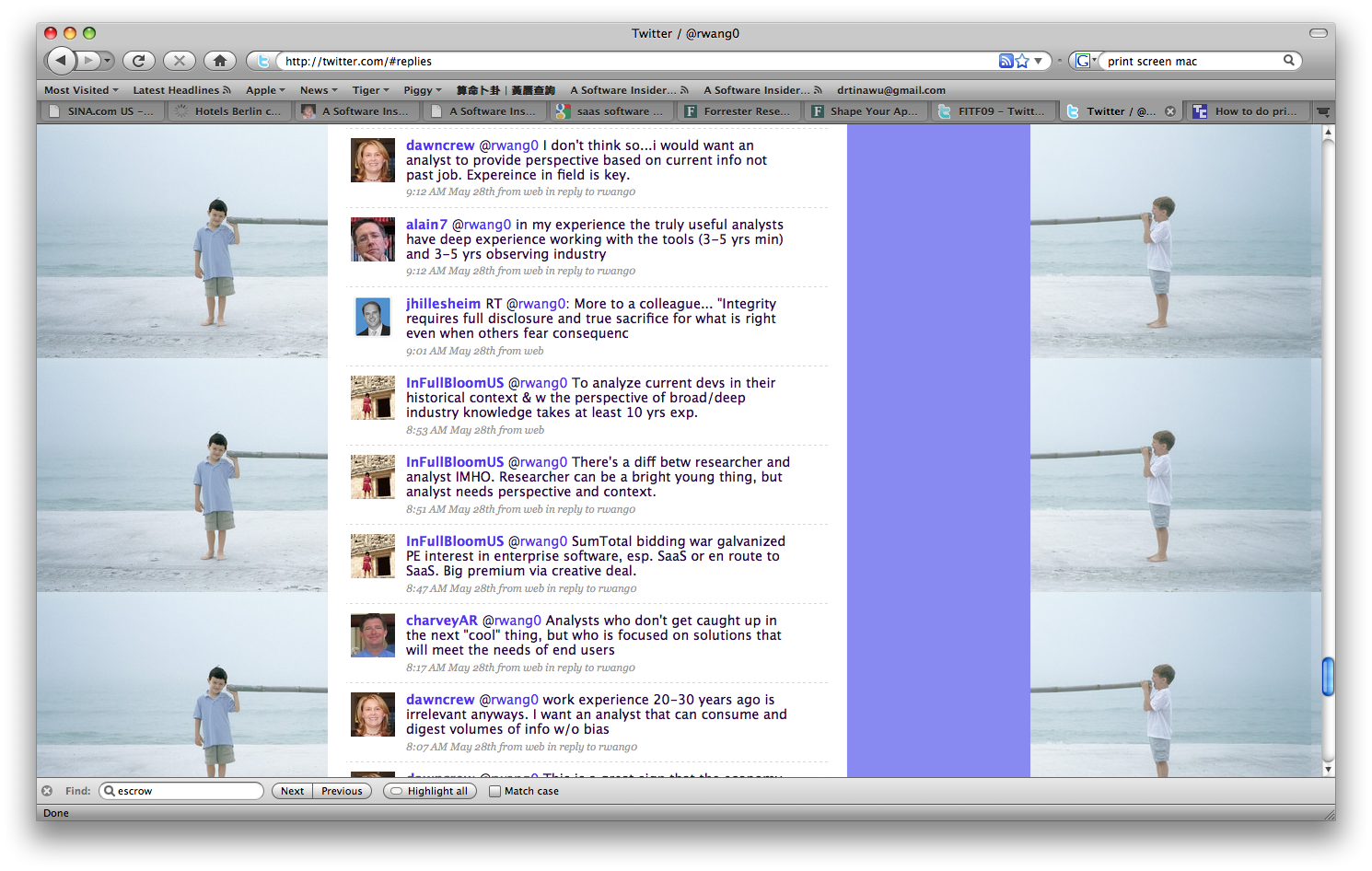
In a quasi-scientific poll of 37 responses, the general arguments fell into to a few camps:
- Vendors seek seasoned analysts they could put in front of their executives and clients with confidence (45.95% or 17/37). As one software vendor AR manager put it, "How can I put my C-level executives in front of a junior analyst who never worked in the industry and tell them that this person is evaluating you?" Alain Breillat (@alain7), a director of product management at Nielsen reinforced this point by stating, "in my experience the truly useful analysts have deep experience working with the tools (3-5 yrs min) and 3-5 yrs observing industry" Star analyst and guru Naomi Bloom (@InFullBloomUS) chimed in with, "To analyze current devs in their historical context & w the perspective of broad/deep industry knowledge takes at least 10 yrs exp."
- End users expect that the analysts bring seasoned expertise to the table (35.13% or 13/37). While there isn't an expectation an analyst can wax technical about the party models and tables in the latest Oracle or SAP app schemas, there is an expectation that analysts can provide actionable advice. Most expect this to be honed by years of experience. One large customer told me at a client site when I first walked into the room, "Son, you look too young to know what the heck you are talking about. I'm giving you 15 minutes". An hour later, he apologized but the point was well taken. I probably should gray my hair and wear some glasses.
- Vendors look for smart, bright analysts who haven't been jaded and can take a fresh perspective (18.92% or 7/37). A few vendors commented that at times the world order of analysts needed to be broken. Politely and professionaly epitomized by Dawn Crew (@dawncrew), a Solution Marketing Director at SAP focused on HCM, she raised the point that " work experience 20 to 30 years ago is irrelevant anyways. I want an analyst that can consume and digest volumes of info w/o bias"
The bottom line -industry analysts have to be able to call BS when there's BS.
It's all in the eye of the beholder what analyst best meets a stakeholder's needs. Josh Weinberg (@kitson) at CRM Magazine summarized the situation as, "Didn't u *expect* vendor&end-user clients to want different qualities in their chosen analysts? The respective needs are different.More curious about different desires (a) by industry and (2) length of client engagement (how long they've been w/you)." Different strokes for different folks! One would expect that industry experience probably helps, especially when a few vendors outright tell tall tales about their technology claims. However, this probably doesn't preclude someone very bright from figuring it out over time. But as a trusted adviser, one would expect industry analysts need to have the context to separate the marketing from the message and make a call. Now nobody wants a jaded curmudgeon, so the solution - side with the gray hairs and their experience. Also, encourage them to be open to new ideas as they come along. Keep the faith! Once in awhile someone a bit younger may actually know what their talking about!
Your POV.
So let me ask you, what do you expect from your industry analysts? Identify yourself as a vendor, end user, media professional, etc. Please post here or send me a private email to rwang0 at gmail dot com.
Copyright © 2009 R Wang. All rights reserved.