 R "Ray" Wang
 R "Ray" Wang
Tuesday's Tip: Use The Organizational Hierarchy Of Needs To Prioritize Apps Strategies

Organization's face significant prioritization challenges as they plan their 2010 apps strategies. Faced with shrinking budgets, competing priorities, increased management scrutiny, outdated legacy apps, and uncertain economic conditions, organizations must answer key questions such as:
- How do I determine which business requirements carry more weight?
- Where do regulatory requirements fit when compared to other priorities?
- What's a good prioritization scheme to rank projects and initiatives?
- Can I justify my budget or request for additional funding?
- When can I move towards social media?
- What's my social enterprise/Web 2.0 / Enterprise 2.0 strategy?
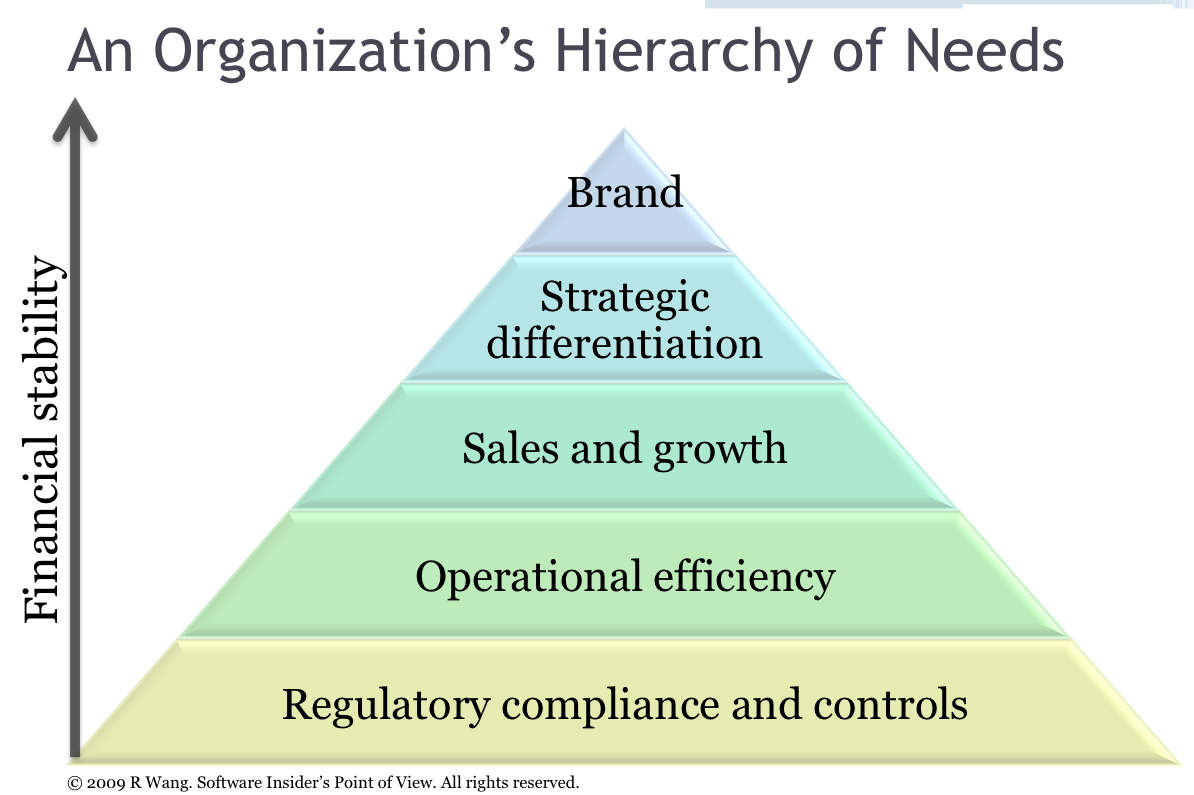
As with Abraham Maslow's motivational theory for individuals, organizations follow a hierarchy of needs. Based on five key stages, the Organizational Hierarchy of Needs provides one proven classification methodology to prioritize business requirements and drivers in determining enterprise apps strategies (see Figure 1). The five stages in detail include initiatives and projects can be defined as:
- Brand - priorities focused on expanding the image and appeal of an organization's outside perception including building connectedness
- Strategic differentiation - priorities that create game changing transformation or business model disruptions including the adoption of newer social enterprise apps or connected business solutions.
- Sales and growth - priorities that drive top line improvements.
- Operational efficiency - priorities that drive business efficiencies including cost optimization, process transformation, and elimination of redundancy.
- Regulatory compliance and controls - priorities that keep the CXO's out of jail, respond to a health and safety requirement, mitigate liabilities, or be compliant with new regulations.
Figure 1. Organizational Hierarchy of Needs
The bottom line - start your apps strategy by applying a prioritization framework of business requirements and drivers
Every project and initiative can be placed into one of the five stages. Use the organizational hierarchy of needs to classify and prioritize the importance of each project. With a clear sense of how the priorities stack up, you can begin crafting your apps strategy around organizational readiness, business process optimization, technology strategy, and vendor ecosystems.
Your POV
Have you begun planning your apps strategy for 2010? If not, do you need assistance in planning out a strategy for 2010? If you have a plan, how well does the Organizational Hierarchy of Needs assist in your efforts? Post your comment here or reach me direct at r at altimetergroup dot com or r at softwareinsider dot org.
Copyright © 2009 R Wang. All rights reserved.