Early Adopters And Pioneers Have Benefited From Social
Across executive board rooms and even in living rooms, social business is all the rage. In 2010, social crm (SCRM) and Enterprise 2.0 (E20) rose into mainstream conversation. Despite the mindshare and awareness, a majority of business leaders have yet to begin these initiatives. The good news – those organizational leaders who have adopted disruptive technologies in social, have already realized the benefits. Those benefits include:
- Faster product time to market and customer adoption
- Reduced marketing spend and increased marketing engagement
- Reduced incident to resolution times that lead to greater customer retention
- Greater market influence and brand awareness
- Improved collaboration across departments and improved knowledge bases
- Growth in the top line and savings in the bottom line
SCRM and E2.0 Evolve Into An Uber Category Of Social Business In 2011
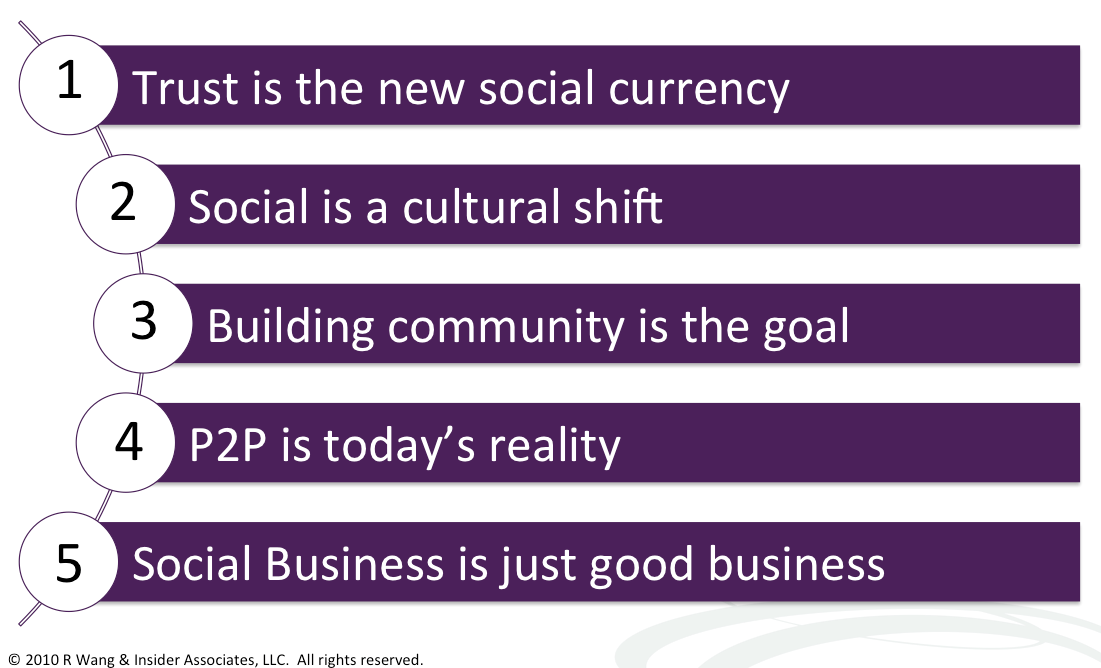
Fast followers have noticed the business benefits and have begun planning for social business initiatives in 2011. Innovative management teams can expect social businesses to bring together the many concepts of social media, social analytics, social media monitoring, social marketing, SCRM, E20, community platforms, and Vendor Relationship Management (VRM). Leaders seeking to understand social business can succeed by following these five simple rules for social business (see Figure 1.):
Figure 1. Five Simple Rules For Social Business

- Trust is the new social currency. Trust drives influence, engagement, and relationships. People and organizations must earn trust through their actions across their relationships. Trust can be expended to gain influence, create engagement, and foster relationships. Trust can be taken away through lack of credibility, bad behaviour, and dishonesty.
- Social is a cultural shift. Social is not a fad. The growing preference for engagement through social channels drives new relationship models. Social has moved beyond the tipping point. How social evolves and permeates our lives is the question. Expect a smaller but strident anti-social movement to counter this current trend. Social is here to stay and is one of the five forces of consumer tech entering the enterprise.
- Building community is the goal. People and organizations seek a sense of belonging. Communities form around personal ecosystems that transcend geographies, time, and individual status. Communities provide the force multipliers to amplify messages through advocates and detractors. Communities require curation and nurturing for success. Once you have a community, organizations and individuals must earn trust to create social currency.
- P2P is today’s reality. B2B and B2C are dead. Social business is conducted through Peer-to-peer (P2P) relationships. Attempts to stove pipe individuals into forced-fit, artificial market segmentations, fail because each individual brings multiple roles to the community. Each role brings a new perspective and a set of expectations in customer experience.
- Social business is just good business. While the moniker social will eventually go away, business has always been social. Breakthroughs in technology and cultural adoption drive the social business phenomenon. However, business can not be conducted without relationships. Social business will be omniscient.
The Bottom Line -Embrace Social In 2011 Or Be Left Behind
The train has left. Organizations must put together a social business strategy that meets their business objectives, matches their organizational culture, and provides the right level of technological support. Expect reference architectures for social business to emerge that incorporate design thinking, innovative user experience models, business API’s, and deeper vertical focus. Not all organizations can and will adopt social business. However, those that succeed will leapfrog their competition with a disruptive technology and business model for 2011 and beyond.
Your POV.
Having trouble convincing management its time for Social Business? Looking to build out a Social Business strategy? You can post or send on to rwang0 at gmail dot com or r at softwaresinsider dot org and we’ll keep your anonymity or better yet, join the community!
Please let us know if you need help with your Social Business efforts. Here’s how we can help:
- Assessing social business/social CRM readiness
- Developing your social business/ social CRM strategy
- Vendor selection
- Implementation partner selection
- Connecting with other pioneers
- Sharing best practices
- Designing a next gen apps strategy
- Providing contract negotiations and software licensing support
- Demystifying software licensing
Resources And Related Research:
- Research Report: How The Five Pillars Of Consumer Tech Influence Enterprise Innovation
- Research Report: Next Gen B2B and B2C E-Commerce Priorities Reflect Macro Level Trends
- News Analysis: Jive Fills Warchest, Ready to Battle Enterprise Software Giants And IPO?
- Tuesday’s Tip: Applying The Five Stages Of Adoption Towards SCRM Projects
- News Analysis: Lithium’s Acquisition of Scout Labs Ups The Ante in Social CRM
- News Analysis: Biz360 Acquisition Signals Attensity Group’s Move Into Social CRM
- Monday’s Musings: Avoiding Failure In Social CRM Projects Requires Ecosystem Coordination
- Research Report: The 18 Use Cases of Social CRM – The New Rules of Relationship Management
- News Analysis: Siperian Acquisition Vaults Informatica Into An MDM Leadership Position
- News Analysis: Jive and Radian6 Partner – Great For Business, But Could Fragment IT Systems
- Event Report: Salesforce.com Pushes Social CRM Technology — But Don’t Expect Companies To Be Successful With Tools Alone
- Monday’s Musings: Why Every Social CRM Initiative Needs An MDM Backbone
- Personal Log: Altimeter Group – Helping Organizations Bridge The Technology Obsolescence Gap
- Monday’s Musings: 10 Essential Elements For Social Enterprise Apps
- Best Practices: Debunking Eight CRM Myths
Reprints
Reprints can be purchased through the Software Insider brand or Constellation Research, Inc. To request official reprints in PDF format, please contact r@softwareinsider.org.
Disclosure
Although we work closely with many mega software vendors, we want you to trust us. For the full disclosure policy, stay tuned for the full client list on the Constellation Research website.
Copyright © 2010 R Wang and Insider Associates, LLC. All rights reserved.


27 Comments »
Another good post, Ray.
There is an implication in what you say that smaller players can, do and will continue to thrive in this new social world (clearly Constellation bears this out).
It bodes well for innovation and progress, although it will mean far less control, which is a mixed blessing.
Great stuff in here!
Cheers,
Sheldon, community manager for Sysomos
Dom – Thanks for the comment. All these tools seemingly put more power into the individual. However, the more networks and nodes we connect, the more privacy we trade off. Not sure who has the net gain. What do you think? – Ray
Sheldon – thanks for the comments. feel free to add more? – Ray
Rising social, environmental, economical & technological challenges together with the 20th century and recent years history are the drivers towards this cultural shift (trust, transparency & multilevel collaborations), which is multidimensional and transcends every aspect of human life: economical (wikinomics), political (wikileaks) social (tribe & community building, migrations & digital nomadism) and technological (environmental challenges & emergence of the Internet (of things)).
This brings us closer to microeconomics optimum of perfect information & competition which better distributes wealth (than situations of imperfect information and competition, the ruling reality during the last 200 years of economic history), a wealth that in turn will be measured more by qualitative growth indicators and not merely by quantitative growth indicators anymore (like GDP).
The challenge will be how we will deal with privacy or what cultural attitude we will be developing towards it…
Anyway, interesting times….expect the next 15 years to be 4 times as fast in change at every level then the last 15 years (which is basically since the Internet started to become mainstream….do you remember how life was before ?)
And design thinking is the management attitude required to deal with this cultural shift.
[...] This post was mentioned on Twitter by Clay Hebert, Sylvain Cottong. Sylvain Cottong said: My comments on @rwang0 's blog on the cultural shift of #socialbusiness #designthinking http://ow.ly/3rp5X [...]
[...] (Read the full article @ A Software Insider’s Point of View) [...]
Great article – simplifying the nuts and bolts concepts, as you always do well.. and a serious stoke to corp leaders to get on board *already*.
No denying it anymore that all this social biz is NOT going away any time soon.
Thought I’d tie in another great article on same theme – also emphasizing the importance of the network as we all go forward. Inside and outside of the organization.
“Rise of the networked enterprise: Web 2.0 finds its payday”
By @dhinchcliffe (Dion Hinchcliffe) http://bit.ly/h6FVf9 ()
[...] Best Practices: Five Simple Rules For Social Business « A Software Insider's Point of View (tags: trends scrm socialmedia business social) [...]
[...] model that actually conforms with what has to be done to engage the social customer in a B2B or B2C or as superstar analyst Ray Wang of the Constellation Research Group, stresses in an important pos…. I’m not the only one who recognized SAP’s transformation. The esteemed Vinnie Mirchandani [...]
[...] Social is a cultural shift. Social is not a fad. The growing preference for engagement through social channels drives new relationship models. Social has moved beyond the tipping point. How social evolves and permeates our lives is the question. Expect a smaller but strident anti-social movement to counter this current trend. Social is here to stay and is one of the five forces of consumer tech entering the enterprise. [...]
[...] Best Practices: Five Simple Rules for Social Business [...]
[...] Best Practices: Five Simple Rules For Social Business [...]
[...] Best Practices: Five Simple Rules For Social Business [...]
[...] Best Practices: Five Simple Rules For Social Business – A good list of references at the end. Unusual selection of five key rules — not sure these are the most important, but thought provoking [...]
[...] Best Practices: Five Simple Rules For Social Business « A Software Insider's Point of View (tags: socialbusiness) [...]
Great stuff, Ray
I especially like your final point- that all good business has always been social. I feel like a lot of the hesitation about social media is the worry that it is all a big hype bubble. It’s important to point out that a lot of what we do are old (and good!) concepts with new tools- taking the buzz word out of the strategy helps sell the idea to skeptics.
Deirdre Yee
Community Manager at Saba Software
Deirdre – thanks for the kind words. appreciate the input. if you think of any other new rules, let me know as you are on the front lines! – Ray
[...] results how do others get in on the goodies? Well, according to a Software Insiders Point of View post you need to follow these five simple [...]
[...] short term gain at a more punishing long term loss of trust. In today’s social businesses, trust is the new social currency. Without trust based on our actions, we destroy the basis for engagement and relationships. In [...]
[...] short term gain at a more punishing long term loss of trust. In today’s social businesses, trust is the new social currency. Without trust based on our actions, we destroy the basis for engagement and relationships. In [...]
I like the Five Simple Rules for Social Business and Trust being the first, I think it should be the last as well, without trust the wheels start to grind to a halt.
Think B2B
Thanks for taking the time to comment When the word Social goes away in mid 2015, this should be interesting
R
[...] been discussed before are how trust will drive the new social economy. An interesting article from Ray at Constellation states that there are 5 simple rules for the social/ connected [...]
[...] Social is a cultural shift. Social is not a fad. The growing preference for engagement through social channels drives new relationship models. Social has moved beyond the tipping point. How social evolves and permeates our lives is the question. Expect a smaller but strident anti-social movement to counter this current trend. Social is here to stay and is one of the five forces of consumer tech entering the enterprise. [...]
[...] been discussed before are how trust will drive the new social economy. An interesting article from Ray at Constellation states that there are 5 simple rules for the social/ connected [...]
[...] need to move on. We really need to. We have got lots of hard work ahead of us still. No matter what people out there may be telling you time and time again, there are *no* best practices for [...]
Leave a comment