 R "Ray" Wang
 R "Ray" Wang
Tuesday's Tip: Dealing With Pesky Software Licensing Audits

Organizations Report Increase In Software Licensing Audits
Across the board, the largest complaints about software vendors and their business practices have come from increasingly aggressive software auditing practices. Once thought to be a small possibility, the software vendors now wield this big stick to drive up sales and of course ensure compliance. Given the 32 percentage gain since Q1 2008 in the percentage of respondents faced with a software audits, procurement managers, CIOs, and CEOs have paid attention (see Figure 1). Even the recent Gartner report from star analyst Jane Disbrow et al. shows that 61% of their customers have been audited by at least one software vendor.
Figure 1. Software Vendors Ramp Up Software Audits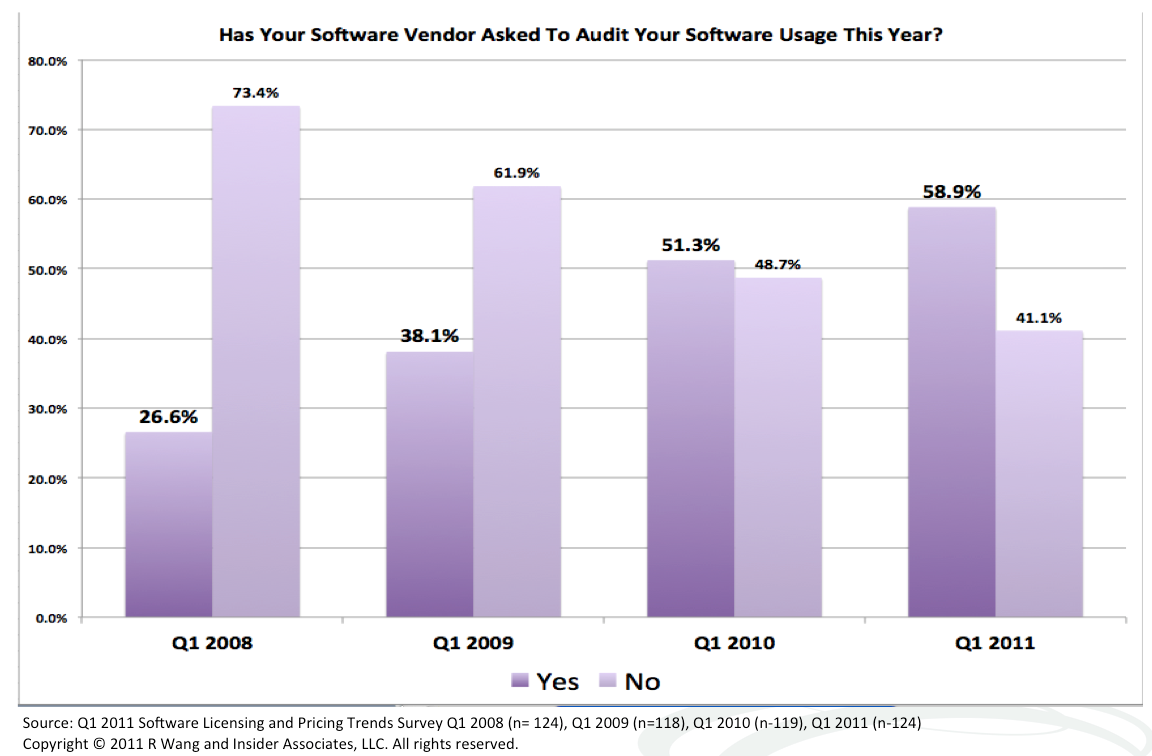
Software Licensing Audits Masquerade As Sales Tactics In Disguise
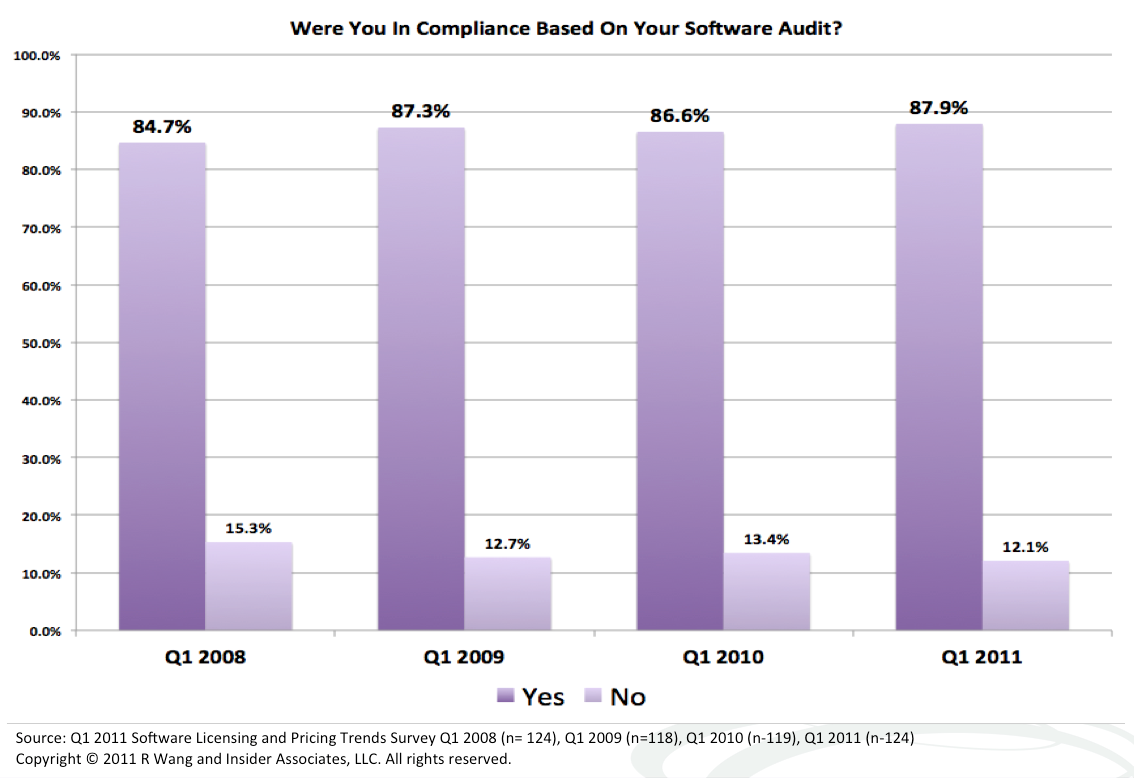
Is this shocking? Should customers be concerned? Given the relatively strong compliance rates in the high 80's, customers should be livid that vendors are willing to jeopardize a relationship to shake down for cash (see Figure 2.). Here are some key reasons for the audit:
- Check for compliance
- Identify installed base competitors
- Drive incremental license sales
- Prospect for up-sell/cross-sell
After speaking with 13 major software vendors, most admitted that software audit served two purposes. The first - keep customers in compliance. The second - shaking the bushes for new deals during the recession.
Figure 2. Most Organizations Were In Compliance Post Software Audit
The Bottom Line: Be Prepared Or Pay Up
To avoid the loss in time and significant agony of participating in a software licensing audit, customers should do the following:
- Keep good records and centralize contracts. Put all our contracts in one place. Keep historical records. Track changes in contract language. Don't forget to include merged and acquired entities.
- Deploy software license management tools to proactively monitor usage. Track your license usage and shelfware. Use software license management tools to automate the process. Advanced users can provision, deploy, manage, and retire licenses with automated tools.
- Include auditing rights provisions in contracts. Secure written notification of an audit at least 60 days in advance. Ask for a project plan and timeline that lists what the audit activities will include. Seek a list of products to be audited. Agree on a noncompliance resolution process. Keep the process nonpunitive for noncompliance between 5 to 10% of total licenses.
- Avoid the upsell and aggressive software sales tactics. As for the right to choose an independent third party to conduct the audit. Customers should have freedom from sales threats of audits as a negotiation tool. Guarantee protection from future audits for at least 24 months if noncompliance remains less than 5 to 15%.
Your POV.
Experiencing an upgrade? How has the experience been? Was your vendor cordial? Was it a sales shakedown or was it sincere? Add your comments to the blog or reach me via email: R (at) ConstellationRG (dot) com or R (at) SoftwareInsider (dot) com.
How can we assist?
Buyers, do you need help with your apps strategy and vendor management strategy? Trying to figure out how to infuse innovation into your tech strategy? Ready to put the expertise of over 1100 software contract negotiations to work? Give us a call!
Please let us know if you need help with your next gen apps strategy efforts. Here’s how we can help:
- Providing contract negotiations and software licensing support
- Evaluating SaaS/Cloud options
- Assessing apps strategies (e.g. single instance, two-tier ERP, upgrade, custom dev, packaged deployments”
- Designing innovation into end to end processes and systems
- Comparing SaaS/Cloud integration strategies
- Assisting with legacy ERP migration
- Engaging in an SCRM strategy
- Planning upgrades and migration
- Performing vendor selection
Related Resources And Links
20090714 Research Summary: An Enterprise Software Licensee’s Bill of Rights, V2
20101214 Tuesday’s Tip: Dealing With Vendor Offers To Cancel Shelfware And Replace With New Licenses
20100308 Monday’s Musings: Decoupling Support From Maintenance – What Apps Vendors Can Learn From Microsoft Dynamics
20100222 Monday’s Musings: Why Users Should Preserve Their Third Party Maintenance Rights
20100104 News Analysis: SAP Revives Two-Tier Maintenance Options
20090210 Tuesday’s Tip: Software Licensing and Pricing – Do Not Give Away Your Third Party Maintenance And Access Rights
20090709 Tuesday’s Tip: Do Not Bundle Your Support and Maintenance Contracts!
20091222 Tuesday’s Tip: 10 Cloud And SaaS Apps Strategies For 2010
20091208 Tuesday’s Tip: 2010 Apps Strategies Should Start With Business Value
20091102 Best Practices: Lessons Learned In What SMB’s Want From Their ERP Provider
20091006 Tuesday’s Tip: Why Free Software Ain’t Really Free
20090504 News Analysis: Oracle Waives Fees On Extended Support Offerings
20080909 Trends: What Customers Want From Maintenance And Support
20080215 Software Licensing and Pricing: Stop the Anti-Competitive Maintenance Fee Madness
20090405 Monday’s Musings: Total Account Value, True Cost of Ownership, And Software Vendor Business Models
20090324 Tuesday’s Tips: Five Simple Steps To Reduce Your Software Maintenance Costs
20090223 Monday’s Musings: Five Programs Some Vendors Have Implemented To Help Clients In An Economic Recession
20091012 Research Report: Customer Bill of Rights – Software-as-a Service
20090910 Tuesday’s Tip: Note To Self – Start Renegotiating Your Q4 Software Maintenance Contracts Now!
20090721 Tuesday’s Tip: 3 Approaches To Return Shelfware
20090127 Tuesday’s Tip: Software Licensing and Pricing – Now’s The Time To Remove “Gag Rule” Clauses In Your Software Contracts
Reprints
Reprints can be purchased through Constellation Research, Inc. To request official reprints in PDF format, please contact sales (at) ConstellationRG (dot) com.
Disclosure
Although we work closely with many mega software vendors, we want you to trust us. For the full disclosure policy, stay tuned for the full client list on the Constellation Research website.
Copyright © 2011 R Wang and Insider Associates, LLC All rights reserved.