 R "Ray" Wang
 R "Ray" Wang
Best Practices: Applying Social Business Challenges To Social Business Maturity Models

Early Adopters Cross Through Five Phases Of Social Business Maturity
Interviews with over 100 early adopters of social business (i.e. social crm, E2.0, social media marketing, etc.) reveal 5 phases of social business maturity (see Figure 1):
- Discovery. A few individuals begin the process of discovering new tools. Individuals identify consumer tech innovations that impact enterprise business processes.
- Experimentation. Small teams experiment with new tools. They fail fast on experiments, learn, and move on.
- Evangelization. Small department leaders seek repeatable processes and begin test pilots of technology. Momentum begins to build for projects.
- Formalization. Successful evangelization leads to enterprise wide acceptance. Processes become repeatable and predictable
- Realization. With a successful project at hand, the enterprise seeks to expand the usage to ecosystem stakeholders. Suppliers, partners, and customers are brought into the fold.
Figure 1. Software Insider's 5 Phase Social Business Maturity Model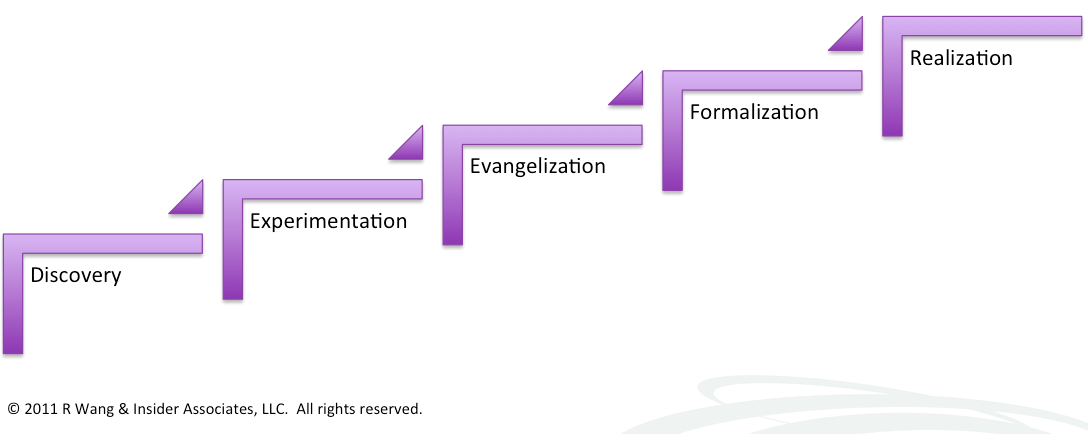
Key Challenges Align With Social Business Maturity Phases
As organizations face challenges in adoption, leaders face key challenges that align with Social Business Maturity (see Figure 2). The 10 challenges Line of Business executives, CMO's, CIO's, Social Strategists, and COO's include:
- Discerning hype from reality.
- Garnering executive support.
- Fostering internal collaboration.
- Choosing the right tools.
- Incorporating social into existing business models.
- Identifying meaningful metrics.
- Scaling to match demand.
- Ensuring long-term funding.
- Keeping up with social innovations.
- Developing social business governance.
Figure 2. 10 Key Challenges Align With Social Business Maturity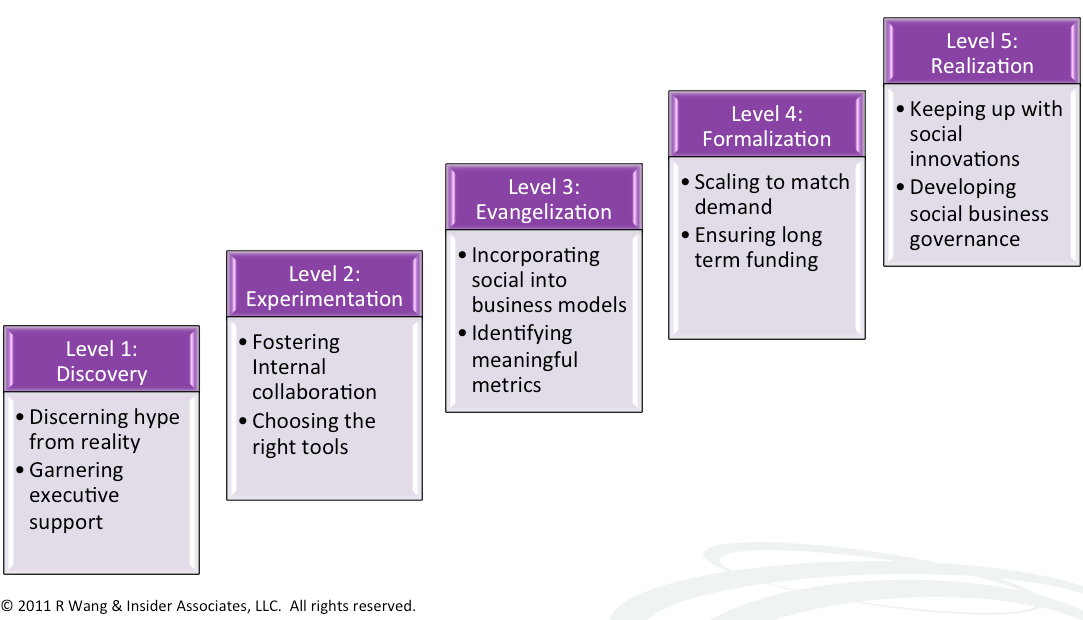
(right click to view full image)
The Bottom Line: Early Adopters Can Anticipate Challenges By Social Business Maturity Model
As with Social CRM adoption, social business adoption will face similar stages of adoption and early adopters should focus on change management and business process design before beginning vendor selection. In the 2010 State of Social Business survey, 45 early adopter indicated challenges with Level 1 issues (see Figure 3.) When asked to list their top 3 social business challenges, 93.33% of chose identifying hype from reality while 80.00% focused on garnering executive support. A little over half the respondents prioritized identifying meaningful metrics. Preliminary results from over 100 interviews in the 2011 State of Social Business survey, hint to a shift to Level 2 issues.
The final findings will be released in a Constellation Research report on the State of Social Business available to clients and selected members of the media.
Figure 3. 2010 State of Social Business Survey Shows Most Challenges Aligned Level 1 Issues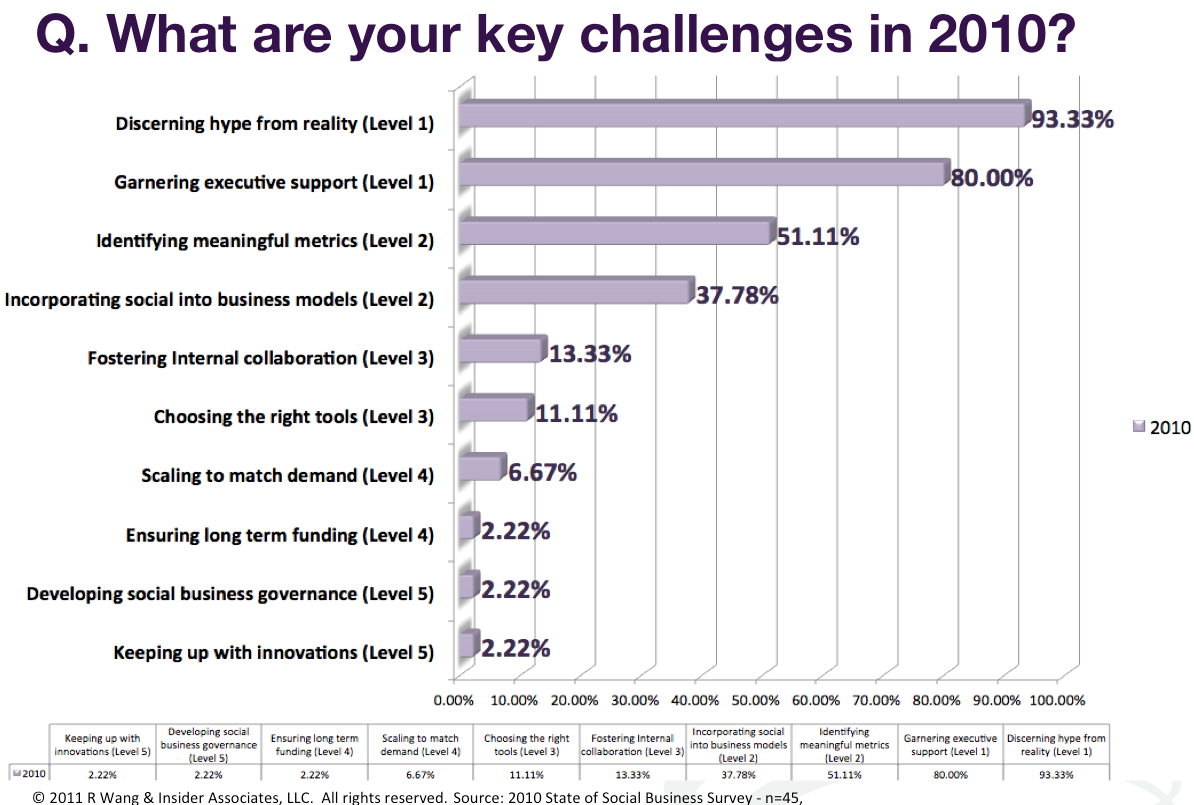
Your POV.
Having trouble convincing management its time for Social Business? Looking to build out a Social Business strategy? Hoping that we'll write a piece of research you're interested in? You can post or send on to rwang0 at gmail dot com or r at softwaresinsider dot org and we’ll keep your anonymity.
Please let us know if you need help with your Social Business efforts. Here’s how we can help:
- Assessing social business/social CRM readiness
- Developing your social business/ social CRM strategy
- Vendor selection
- Implementation partner selection
- Connecting with other pioneers
- Sharing best practices
- Designing a next gen apps strategy
- Providing contract negotiations and software licensing support
- Demystifying software licensing
Resources And Related Research:
- Best Practices: Five Simple Rules For Social Business
- Research Report: How The Five Pillars Of Consumer Tech Influence Enterprise Innovation
- Research Report: Next Gen B2B and B2C E-Commerce Priorities Reflect Macro Level Trends
- News Analysis: Jive Fills Warchest, Ready to Battle Enterprise Software Giants And IPO?
- Tuesday’s Tip: Applying The Five Stages Of Adoption Towards SCRM Projects
- News Analysis: Lithium’s Acquisition of Scout Labs Ups The Ante in Social CRM
- News Analysis: Biz360 Acquisition Signals Attensity Group’s Move Into Social CRM
- Monday’s Musings: Avoiding Failure In Social CRM Projects Requires Ecosystem Coordination
- Research Report: The 18 Use Cases of Social CRM – The New Rules of Relationship Management
- News Analysis: Siperian Acquisition Vaults Informatica Into An MDM Leadership Position
- News Analysis: Jive and Radian6 Partner – Great For Business, But Could Fragment IT Systems
- Event Report: Salesforce.com Pushes Social CRM Technology — But Don’t Expect Companies To Be Successful With Tools Alone
- Monday’s Musings: Why Every Social CRM Initiative Needs An MDM Backbone
- Personal Log: Altimeter Group – Helping Organizations Bridge The Technology Obsolescence Gap
- Monday’s Musings: 10 Essential Elements For Social Enterprise Apps
- Best Practices: Debunking Eight CRM Myths
Reprints
Reprints can be purchased through the Software Insider brand or Constellation Research, Inc. To request official reprints in PDF format, please contact [email protected].
Disclosure
Although we work closely with many mega software vendors, we want you to trust us. For the full disclosure policy, stay tuned for the full client list on the Constellation Research website.
Copyright © 2011 R Wang and Insider Associates, LLC. All rights reserved.